Sunday, 31 March 2013
Saturday, 30 March 2013
March 30
The most notable of his works:
| The Lace Maker, 1823 |
:
| Girl from Podillya, 1804-1807 |
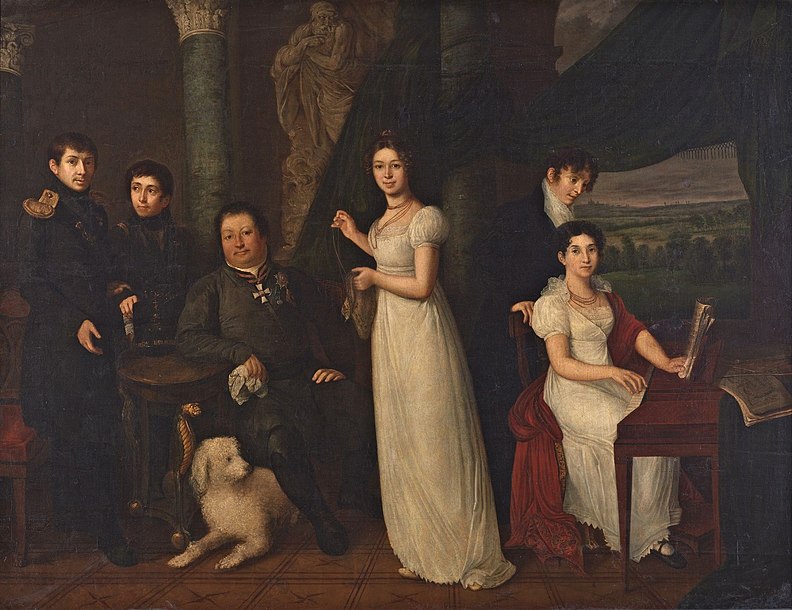
| Family portrait of counts Morkovs, 1813 |
Friday, 29 March 2013
March 29
Prince Alexander
Sergeevich Obolensky
(Russian: Александр Сергеевич Оболенский; 17 February 1916 — 29 March 1940) was
a Rurikid prince of Russian origin who became a naturalised Briton, having
spent most of his life in England ,
and who went on to represent England
in International Rugby Union. He was, and is, popularly known as "The
Flying Prince", "The Flying Slav", or simply as "Obo"
by many sports fans.
A member of the Rurik Dynasty,[1] he was born
in Petrograd (now Saint Petersburg) on 17 February 1916 and was the son of
Prince Serge Obolensky, an officer in the Czar's Imperial Horse Guards, and his
wife Princess Lubov' (née Naryshkina). Their name derived from the Russian town
of
Prince Obolensky won three caps for England later that year (against Wales on 18 January, Ireland
on 8 February and Scotland
on 21 March), and scored no further tries. He was selected as a member of the
touring party for the 1936 British Lions tour to Argentina .
By August 1939, Obolensky was already serving
as an A/P/O with 615 Squadron, Auxiliary Air Force, stationed at Kenley; and,
on the outbreak of World War II in 1939, he joined the Royal Air Force's 504
Squadron.
Stanislav Sergeyevich
Govorukhin PAR
(Russian: Станислав Сергеевич Говорухин) (born March 29, 1936 in Berezniki , Perm Krai,[1] Russian SFSR) has
been one of the most popular Soviet and Russian film directors since the 1960s.
His films, often featuring detective or adventure plots, are commonly dominated
by strong male characters who seek to revenge criminal acts but have to eschew
commonly accepted social norms in order to succeed.
Govorukhin has been a member of the State Duma
since its inauguration in 1993, running the Duma culture committee for some
time. Following the 1993 Russian constitutional crisis, he had abandoned his
previous democratic anti-communist convictions and sided with the
national-communist opposition. In 1996, he supported Gennady Zyuganov against
Boris Yeltsin during the second round of the presidential election campaign. In
2000, he took part in Russian presidential elections, but failed to be elected.
At a Duma by-election in 2005, Govorukhin's opponent, the journalist and
satirist Victor Shenderovich, accused him of using illegal funds to guarantee
his victory.
In 2009 Stanislav Govorukhin started to shoot a
movie by Ksenya Stepanycheva screenplay; the movie’s name is “Hearts of Four”.
Thursday, 28 March 2013
March 28
Mitta's birth name was Alexander Naumovich Rabinovich (Рабино́вич). He studied engineering (graduated in 1955), then worked as a cartoonist in art and humour magazines. In 1960 Mitta graduated at the film directing faculty of the VGIK.
Mitta's career as film director and screenwriter spans from the 1960s until the 2000s. Among the movies are Gori, gori, moya zvezda (Гори, гори, моя звезда, 1969) about actors trying to survive and work during the time of the Russian revolution or the high budget catastrophe movie Air Crew (1979). For his work Mitta obtained numerous awards in the Soviet Union and Russia.
In 1980, he was a member of the jury at the 30th Berlin International Film Festival
Wednesday, 27 March 2013
March 27
World Theatre Day is the
creation of the International Theatre Institute (ITI). It is celebrated
annually on the 27th March by ITI Centres and the international theatre
community. Various national and international theatre events are organized to
mark this occasion. One of the most important of these is the circulation of
the World Theatre Day International Message through which at the invitation of
ITI, a figure of world stature shares his or her reflections on the theme of
Theatre and a Culture of Peace. The first World Theatre Day International
Message was written by Jean Cocteau (France) in 1962.
Each year a figure
outstanding in theatre or a person outstanding in heart and spirit from another
field, is invited to share his or her reflections on theatre and international
harmony. What is known as the International Message is translated into more
than 20 languages, read for tens of thousands of spectators before performances
in theatres throughout the world and printed in hundreds of daily newspapers.
Colleagues in the audio-visual field lend a fraternal hand, with more than a
hundred radio and television stations transmitting the Message to listeners in
all corners of the five continents.
Tuesday, 26 March 2013
March 26
Andrey Ivanovich Lavrov (born March 26, 1962 in Krasnodar) is a Russian handball goalkeeper and the only three times Olympic handball champion.
Lavrov is also the only athlete to have won Olympic gold medals for three different nation's teams, winning gold for Soviet Union in 1988, the Unified Team in 1992, and for Russia in 2000. Four years later, at the age of 42, he won his fourth olympic medal, another unique feat for a handball player, when his Russian team earned third place and the bronze medals at the 2004 Athens Olympic games. Lavrov was a long time captain for the Russian handball team, and he was Flag Bearer for the Russian athletes at the 2000 Summer Olympics Opening Ceremony of the Sydney Summer Olympics. Lavrov has also won two World Championships for Russia, in 1993 and in 1997, as well as the European Championship in 1996. In 2001, Andrey Lavrov was voted "Russian handball player of the century" in his home country.
Konstantin Alekseevich Andreev (14 March 1848 – 29 October 1921) was a Russian mathematician, best known for his work on geometry, especially projective geometry. He was one of the founders of the Kharkov Mathematical Society. This society is one of the early mathematics societies in Russia and was founded in 1879.
Eduard
Viktorovich Dyomin (born
March 26, 1974) is a former Russian footballer, now a coach for FC Kaluga. He
made his debut in the Russian Premier League in 1993 for FC Asmaral Moscow and
played 1 game in the UEFA Cup 1996–97 for FC Dynamo Moscow.
Monday, 25 March 2013
March 25
Efim (Nakhim) Zalmanovich Shifrin
(born on March 25, 1956)– Soviet and Russian actor.
Efim Shifrin was born in 1956 in Magadan region (Neksikan village). In 1973—1974 he studied at philological faculty of Latvian University, and from 1974 to 1978 at stage department of State University of Circus and Stage Art, at the course of Roman Viktiuk.
Since 1977 he started to play in his stage studio of Moscow State University. Among Efim’s theatre works of that time there are the performances «Good-buy, Boys!», «The Night After Release», «Duck Hunting». In 1979 Efim Shifrin became prize winner of the 1st Moscow Contest of Stage Actors. In 1983 Shifrin became prize winner of the 7th USSR’s Contest of Stage Actors. The first solo performance «I Would Like to Say», mainly based on works by Viktor Kokliushkin, was played by Shifrin in 1985. Texts of V. Kokliushkin also became the base of performances «Three Questions» and «Round Moon».
Subscribe to:
Posts (Atom)