Thursday, 7 March 2013

March 7


Boris Mikhaylovich Kustodiev


Boris Mikhaylovich Kustodiev (March 7, 1878 – May 28, 1927) was a Russian painter and stage designer.


Between 1893 and 1896, Boris studied in theological seminary and took private art lessons in Astrakhan from Pavel Vlasov, a pupil of Vasily Perov. Subsequently, from 1896 to 1903, he attended Ilya Repin’s studio at the Imperial Academy of Arts in St. Petersburg. Concurrently, he took classes in sculpture under Dmitry Stelletsky and in etching underVasiliy Mate. He first exhibited in 1896.

"I have great hopes for Kustodiev," wrote Repin. "He is a talented artist and a thoughtful and serious man with a deep love of art; he is making a careful study of nature..." When Repin was commissioned to paint a large-scale canvas to commemorate the 100th anniversary of the State Council, he invited Kustodiev to be his assistant. The painting was extremely complex and involved a great deal of hard work. Together with his teacher, the young artist made portrait studies for the painting, and then executed the right-hand side of the final work.Also at this time, Kustodiev made a series of portraits of contemporaries whom he felt to be his spiritual comrades. These included the artist Ivan Bilibin (1901,Russian Museum), Moldovtsev (1901, Krasnodar Regional Art Museum), and the engraver Mate (1902, Russian Museum). Working on these portraits considerably helped the artist, forcing him to make a close study of his model and to penetrate the complex world of the human soul.


In 1903, he married Julia Proshinskaya (1880–1942).
He visited France and Spain on a grant from the Imperial Academy of Arts in 1904. Also in 1904, he attended the private studio of René Ménard in Paris. After that he traveled to Spain, then, in 1907, to Italy, and in 1909 he visited Austria and Germany, and again France and Italy. During these years he painted many portraits and genre pieces. However, no matter where Kustodiev happened to be – in sunny Seville or in the park at Versailles – he felt the irresistible pull of his motherland. After five months in France he returned to Russia, writing with evident joy to his friend Mate that he was back once more "in our blessed Russian land".


Wednesday, 6 March 2013

March 6


     Mikhail Mikhaylovich Zhvanetsky (Russian: Михаи́л Миха́йлович Жване́цкий; Ukrainian: Михайло Михайлович Жванецький, transliterated:Mykhailo Mykhailovych Zhvanetsky) (born 6 March 1934, Odessa, Ukrainian SSR, Soviet Union) is best known for his shows targeting different aspects of the Soviet and post-Soviet everyday life. His monologues have been interpreted by other actors including Arkady Raikin, Roman Kartsevand Viktor Ilchenko. Zhvanetsky is a member of the Union of Soviet Writers since 1978 and has authored several books.
     Zhvanetsky's monologues and sketches were performed by Arkady Raikin, Roman Kartsev and Viktor Ilchenko. He joined the Union of Soviet Writersin 1978 and has authored several books of humor and satire.


     Vasily Vasilyevich Mate (Russian: Василий Васильевич Матэ; 1856–1917), or Mathé, was a Russian artist and engraver. While he was not the author of any major original works, he was one of the major engravers in Russia during the late 19th century. He collaborated with major Russian painters and produced engravings of their paintings, thus helping popularize Russian art.

Tuesday, 5 March 2013

March 5

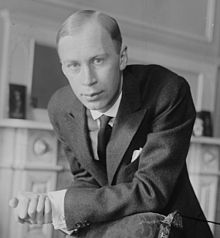
The day of the death of a Russian Composer Sergei Prokofiev.


Sergei Sergeyevich Prokofiev (23 April 1891 – 5 March 1953) was a Russian composer, pianist and conductor who mastered numerous musical genres and is regarded as one of the major composers of the 20th century. His best-known works are the five piano concertos, nine completed piano sonatas and seven symphonies. Besides many other works, Prokofiev also composed family favourites, such as the March from The Love for Three Oranges, the suite Lieutenant Kijé, the ballet Romeo and Juliet – from which "Dance of the Knights" is taken – and Peter and the Wolf.


A graduate of the St Petersburg Conservatory, Prokofiev initially made his name as an iconoclastic composer-pianist, achieving notoriety with a series of ferociously dissonant and virtuosic works for his instrument and his first two piano concertos. Prokofiev's first major success breaking out of the composer-pianist mould was with his purely orchestral Scythian Suite, compiled from music originally composed for a ballet commissioned by Sergei Diaghilev of the Ballets Russes; Diaghilev commissioned three further ballets from Prokofiev – Chout, Le pas d'acier and The Prodigal Son – which at the time of their original production were all highly successful. Prokofiev's greatest interest, however, was opera, and he composed several works in that genre, including The Gambler and The Fiery Angel. Prokofiev's one relative success in that genre during his lifetime was The Love for Three Oranges, composed for Chicago and subsequently performed over the following decade in Europe and Russia.


After the Revolution, Prokofiev left Russia with the official blessing of the Soviet minister Anatoly Lunacharsky, and he lived in the United States, then Germany, then Paris, during which time he married a Spanish singer, Carolina Codina, with whom he had two sons. Because of the increasing economic deprivation of Europe, Prokofiev returned to Russia in 1936. He enjoyed some success there – notably with Lieutenant Kijé, Peter and the Wolf, Romeo and Juliet, and perhaps above all with Alexander Nevsky. The Nazi invasion of the USSR spurred him to compose his most ambitious work, an operatic version of Leo Tolstoy's War and Peace. In 1948 Prokofiev was criticized for "anti-democratic formalism", and with his income severely curtailed was forced to compose Stalinist works such as On Guard for Peace. However, he also enjoyed personal and artistic support from a new generation of Russian performers, notably Sviatoslav Richter and Mstislav Rostropovich and for the latter he composed his Symphony-Concerto.

Monday, 4 March 2013

March 4


Vyacheslav Aleksandrovich Malafeev  is a footballer who plays as a goalkeeper for Russian Premier League team Zenit Saint Petersburg. He is a one-club man, having spent all 12 of his professional seasons with Zenit. Vyacheslav Malafeev started attending the Smena football school at the age of nine. In 1997, he began to play for the farm club of FC Zenit, Zenit-2, in the Third Division. He got the chance to play for Zenit in the Premier League in 1999 during the suspension of Roman Berezovsky. Malafeev later became the first choice goalkeeper for Zenit in 2001, after Berezovsky left the club. Malafeev has since been the first choice goalkeeper ahead of Kamil Čontofalský and won the UEFA Cup in 2008 after keeping a clean sheet against Rangers F.C. On 19 November 2003, Malafeev debuted as a goalkeeper for the national team in a Euro 2004 qualifiers play-off against Wales. He was chosen as the second choice goalkeeper behind Sergei Ovchinnikov and ahead of Igor Akinfeev. Malafeev participated in Euro 2004 coming on after Ovchinnikov's red card against Portugal and starting against Greece. After Euro 2004, Malafeev, became the first choice goalkeeper for Russia succeeding Ovchinnikov. After a long-term injury in May 2005, Malafeev lost his place in the goal for Zenit and Russia to Kamil Čontofalský and Igor Akinfeev, respectively. In 2007, played in two Euro 2008 qualifiers against Andorra and Croatia after Akinfeev's long term injury but was relegated to the bench in favor of Vladimir Gabulov. After Zenit's successful UEFA Cup campaign he lost a narrow battle with Igor Akinfeev for the first choice goalkeeper spot in Russia's Euro 2008 squad. Nonetheless, he stayed on the as the second choice goalkeeper ahead of Gabulov.He was the starting goalkeeper in the game that Russia lost to Portugal with a score of 1–7 in the 2006 FIFA World Cup qualifier. He was confirmed for the finalized UEFA Euro 2012 squad on 25 May 2012. After the UEFA Euro 2012 he announced that he is retiring from the national team to spend more time with his children, but is prepared to be called up in case of emergency such as injuries to other top goalkeepers.


Sunday, 3 March 2013

March 3

Alexander Valerevich Semin


 [born March 3, 1984) is a Russian professional ice hockey player with the Carolina Hurricanes of the National Hockey League (NHL). He had previously played for the Washington Capitals.


Saturday, 2 March 2013

March 2


Vyacheslav Mikhailovich Zaitsev 

More commonly known as Slava Zaitsev, born 2 March 1938 in Ivanovo, Russian Soviet Federative Socialist Republic, is a Russian fashion designer, painter, graphic artist and theatrical costume designer.
In 2007 Zaitsev took part in the TV show "Fashion Sentence" (Russian: Модный приговор) on Channel One, in which he acted as a judge passing down sentence on contestant's fashion sense.


Friday, 1 March 2013

March 1

Aleksandr Yakovlevich Golovin (March 1 1863 - April 17, 1930) was a Russian artist and stage designer. He designed productions for Sergei Diaghilev, Constantin Stanislavski, and Vsevolod Meyerhold.


Rashid Alievich Sunyaev (born March 1, 1943) to a Tatar family, and educated at the Moscow Institute of Physics and Technology. He became a professor at MIPT in 1974.

Sunyaev and Yakov B. Zel'dovich developed the theory for the evolution of density fluctuations in the early universe. They predicted the pattern of acoustic fluctuations that have been clearly seen by WMAP and other CMB experiments in the microwave sky and in the large-scale distribution of galaxies. With Yakov B. Zel'dovich, at the Moscow Institute of Applied Mathematics, he proposed what is known as the Sunyaev-Zel'dovich effect, which is due to electrons associated with gas in galaxy clusters scattering the cosmic microwave background radiation.